
Reproductive Health NEET Notes PDF download
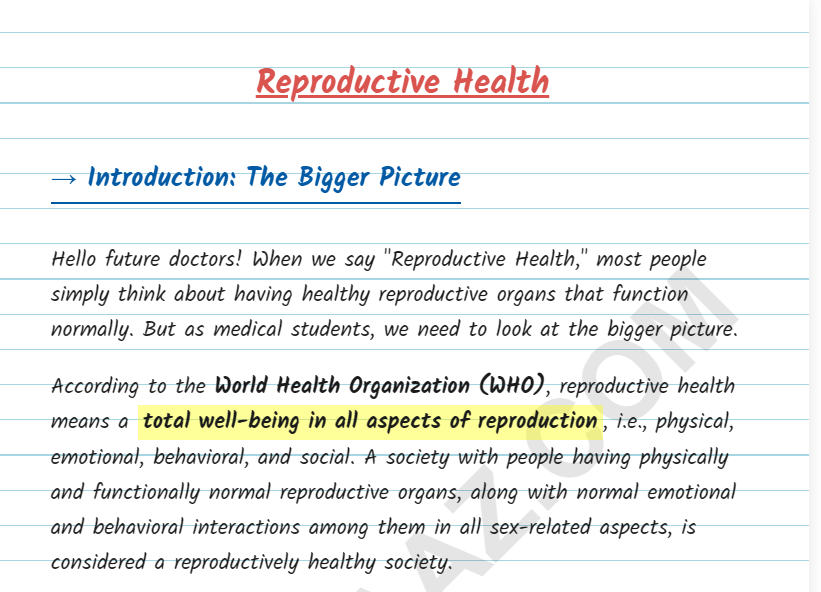
→ Introduction: The Bigger Picture
Hello future doctors! When we say "Reproductive Health," most people simply think about having healthy reproductive organs that function normally. But as medical students, we need to look at the bigger picture.
According to the World Health Organization (WHO), reproductive health means a total well-being in all aspects of reproduction, i.e., physical, emotional, behavioral, and social. A society with people having physically and functionally normal reproductive organs, along with normal emotional and behavioral interactions among them in all sex-related aspects, is considered a reproductively healthy society.
→ Problems and Strategies: India's Pioneer Move
Did you know? India was amongst the first countries in the world to initiate action plans and programs at a national level to attain total reproductive health as a social goal.
- Family Planning Programs: These were initiated all the way back in 1951 and were periodically assessed over the past decades.
- RCH Programs: Today, these improved and expanded programs are operating under the popular name Reproductive and Child Health Care (RCH) programmes.
Major Tasks Under RCH Programs:
Creating massive awareness is step one. How do we do it? Through audio-visual and print media, government agencies, and NGOs. But at a micro-level, parents, close relatives, teachers, and friends play a crucial role.
- Sex Education in Schools: It is absolutely necessary to provide the right information to the youth so they don't fall for dangerous myths and misconceptions about sex-related aspects.
- Awareness about STIs and Hygiene: Educating people, especially those in the fertile age group, about available birth control options, care of pregnant mothers, postnatal care of the mother and child, and the massive importance of breastfeeding.
- Equal Opportunities: Highlighting equal opportunities for the male and female child to curb gender-based crimes and biases.
Amniocentesis is a highly specialized medical procedure used to diagnose chromosomal abnormalities (like Down syndrome, Klinefelter's) or genetic disorders (like hemophilia, sickle-cell anemia) in the developing fetus. A doctor extracts a small amount of amniotic fluid, which contains fetal skin cells and biochemicals.
The Misuse: Unfortunately, people started using it illegally to determine the sex of the unborn child. If the fetus was female, it often led to female foeticide. Therefore, a statutory ban on amniocentesis for sex determination was legally enforced in India to check the increasing menace of female foeticides.
→ Population Explosion & Birth Control
Let's look at some terrifying numbers. The world population was around 2 billion in 1900. By 2000, it rocketed to 6 billion, and by 2011 it crossed 7.2 billion! India's population crossed 1.2 billion in May 2011. What caused this sudden massive explosion?
- A rapid decline in the overall Death Rate due to better medical facilities.
- A rapid decline in Maternal Mortality Rate (MMR).
- A rapid decline in Infant Mortality Rate (IMR).
- An increase in the number of people in the reproducible age group.
Through the RCH programs, we managed to bring down the population growth rate, but it was still around 1.7% (according to the 2011 census). At this rate, our population could double in just 33 years! To combat this, the government took steps like raising the statutory marriageable age (18 for females, 21 for males) and offering incentives to small families. But the most effective step is the widespread use of Contraceptives.
Features of an Ideal Contraceptive:
If you are prescribing a contraceptive to a patient, it should be: User-friendly, easily available, highly effective, completely reversible, with no or least side-effects. Most importantly, it should in no way interfere with the sexual drive, desire, or the sexual act of the user.
→ Methods of Contraception
We classify modern contraceptives into several distinct categories. Let's break them down for the NEET exam.
1. Natural / Traditional Methods
These methods work purely on the principle of avoiding chances of the ovum and sperms meeting. Because no medicines or devices are used, side effects are almost nil, but the chances of failure are extremely high.
- Periodic Abstinence: Couples avoid coitus from Day 10 to 17 of the menstrual cycle. This period is called the fertile window because ovulation (Day 14) is highly expected. Avoiding sex during this time prevents conception.
- Withdrawal or Coitus Interruptus: The male partner withdraws his penis from the vagina just before ejaculation to avoid insemination.
- Lactational Amenorrhea: This is the natural absence of menstruation. After parturition (delivery), during the period of intense lactation (breastfeeding), ovulation does not occur due to high prolactin levels. Therefore, chances of conception are almost nil. However, this method is only effective up to a maximum of 6 months following delivery.
2. Barrier Methods
In this method, ovum and sperms are prevented from physically meeting with the help of barriers. These are available for both males and females.
- Condoms: Made of thin rubber/latex sheath. "Nirodh" is a popular brand for males. They cover the penis in males or the vagina/cervix in females just before coitus. Major Bonus: Condoms are the ONLY contraceptive method that also heavily protects the user from Sexually Transmitted Infections (STIs) and AIDS.
- Diaphragms, Cervical Caps, and Vaults: These are barriers made of rubber that are inserted into the female reproductive tract to cover the cervix before coitus. Unlike male condoms, these are reusable. Spermicidal creams, jellies, and foams are usually used along with them to drastically increase contraceptive efficiency.
These are highly effective devices inserted by doctors or expert nurses into the uterus through the vagina. IUDs are presently available as:
- Non-medicated IUDs: (e.g., Lippes loop). They physically increase phagocytosis (eating up) of sperms within the uterus.
- Copper releasing IUDs: (e.g., CuT, Cu7, Multiload 375). The Copper (Cu) ions released strongly suppress sperm motility and drastically reduce the fertilizing capacity of sperms.
- Hormone releasing IUDs: (e.g., Progestasert, LNG-20). They make the uterus unsuitable for implantation and make the cervix incredibly hostile to the sperms by thickening the cervical mucus.
Conclusion: IUDs are ideal contraceptives for females who want to delay pregnancy or space children. It is one of the most widely accepted methods in India.
3. Oral Contraceptives (Pills)
These are small doses of either progestogens alone or a progestogen-estrogen combination, taken orally by females. They work mainly by inhibiting ovulation and implantation, and they also alter the quality of cervical mucus to retard the entry of sperms.
- Pills have to be taken daily for a period of 21 days, starting preferably within the first five days of the menstrual cycle. After a gap of 7 days (during which menstruation occurs), the cycle is repeated.
- Saheli: The new oral contraceptive for females. It was developed by scientists at the Central Drug Research Institute (CDRI) in Lucknow, India. It contains a non-steroidal preparation (Centchroman). It is a 'once-a-week' pill with very few side effects and high contraceptive value.
4. Injectables and Implants
Progestogens alone or in combination with estrogen can also be used by females as injections or implants placed directly under the skin (usually in the upper arm). Their mode of action is exactly like oral pills, but their effective periods are much longer (lasting several years).
5. Surgical Methods (Sterilization)
Surgical intervention blocks gamete transport and thereby permanently prevents conception. It is a highly effective, terminal method to prevent any more pregnancies, but its reversibility is very poor.
- Vasectomy (In Males): A small part of the vas deferens is removed or tied up through a small incision on the scrotum.
- Tubectomy (In Females): A small part of the fallopian tube is removed or tied up through a small incision in the abdomen or through the vagina.
→ Medical Termination of Pregnancy (MTP)
Intentional or voluntary termination of pregnancy before full term is called Medical Termination of Pregnancy (MTP) or induced abortion. Nearly 45 to 50 million MTPs are performed in a year all over the world, which accounts for 1/5th of the total number of conceived pregnancies!
The Government of India legalized MTP in 1971 with some strict conditions to avoid its misuse (especially illegal female foeticide).
MTPs are considered relatively safe during the first trimester (up to 12 weeks of pregnancy). Second-trimester abortions are much more medically risky.
According to the Medical Termination of Pregnancy (Amendment) Act 2017: A pregnancy may be terminated on certain considered grounds within the first 12 weeks of pregnancy on the opinion of one registered medical practitioner. If the pregnancy has lasted more than 12 weeks, but fewer than 24 weeks, two registered medical practitioners must be of the opinion that the pregnancy involves a severe risk to the life of the pregnant woman or grave physical/mental injury to the child.
→ Sexually Transmitted Infections (STIs)
Diseases or infections which are transmitted through sexual intercourse are collectively called Sexually Transmitted Infections (STI) or Venereal Diseases (VD) or Reproductive Tract Infections (RTI).
Common STIs: Gonorrhoea, syphilis, genital herpes, chlamydiasis, genital warts, trichomoniasis, hepatitis-B, and of course, the most dangerous of all, HIV leading to AIDS.
NEET Exemption Rule: Except for Hepatitis-B, genital herpes, and HIV infections, all other diseases are completely curable if detected early and treated properly with specific antibiotics.
Symptoms and Complications:
Early symptoms of most STIs are minor: itching, fluid discharge, slight pain, swellings in the genital region. Because of this, many infected females may remain asymptomatic and the infection goes undetected.
Absence of early symptoms and the social stigma attached to STIs deter people from seeking timely medical help. This delay leads to severe complications later, such as: Pelvic Inflammatory Diseases (PID), spontaneous abortions, stillbirths, ectopic pregnancies (pregnancy outside the uterus), infertility, or even cancer of the reproductive tract.
→ Infertility and Assisted Reproductive Technologies (ART)
Infertility is defined as the inability to produce children in spite of unprotected sexual co-habitation. The reasons could be physical, congenital, diseases, drugs, immunological, or even psychological.
In India, society often unfairly blames the female for being childless, but medically, the problem frequently lies in the male partner (e.g., low sperm count, poor motility). Where medical or surgical corrections are not possible, couples can be assisted to have children through special, highly advanced techniques known as Assisted Reproductive Technologies (ART).
1. In Vitro Fertilization (IVF) - "Test Tube Baby" Program
In this method, fertilization takes place outside the body in almost similar conditions as that in the body, followed by embryo transfer (ET) into the female.
- Ova from the wife/donor (female) and sperms from the husband/donor (male) are collected and induced to form a zygote under simulated conditions in the laboratory.
- ZIFT (Zygote Intra Fallopian Transfer): The zygote or early embryos (with up to 8 blastomeres) are transferred directly into the fallopian tube.
- IUT (Intra Uterine Transfer): Embryos with more than 8 blastomeres are transferred directly into the uterus, to complete further development.
2. In Vivo Fertilization Techniques
Embryos formed by in-vivo fertilization (fusion of gametes within the female tract) can also be used for transfer to assist those females who cannot conceive natively.
- GIFT (Gamete Intra Fallopian Transfer): Transfer of an ovum collected from a donor into the fallopian tube of another female who cannot produce one herself, but can provide a suitable environment for fertilization and further development.
- ICSI (Intra Cytoplasmic Sperm Injection): A highly specialized procedure to form an embryo in the lab where a single sperm is directly injected into the ovum using microscopic needles. This is great for males with very low sperm counts.
3. Artificial Insemination (AI)
This technique is highly useful when the infertility is due to the inability of the male partner to inseminate the female or due to very low sperm counts (oligospermia) in the ejaculates.
The semen is collected either from the husband or a healthy donor and is artificially introduced either into the vagina or directly into the uterus (IUI – Intra Uterine Insemination) of the female.
While all these ART techniques are medical miracles and have helped many couples, they require extremely high precision, specialized professionals, and very expensive instrumentation. Therefore, these facilities are presently available only in a few major centers in India. As emotional, religious, and social factors play a big role, our society must remember that legally adopting orphaned or destitute children is perhaps one of the best and most humane ways to become parents!
Securing a top rank in the medical entrance exam requires smart work, especially when tackling high-yield, data-heavy chapters in Biology. If you want to maximize your score in minimum time, you need the Reproductive Health NEET Notes PDF, Classroom Study Notes. We strongly advise every medical aspirant to grab these Reproductive Health NEET Notes, Download PDF. Prepare for NEET Biology with detailed NEET Notes for the Reproductive Health chapter and ensure not a single mark slips through your fingers.
Reproductive Health is a comparatively small chapter in Class 12 Biology, but it consistently delivers 2 to 3 direct questions (8 to 12 marks) every year. The NTA loves picking factual data, years, and abbreviations straight from the NCERT lines. Our Rankbaaz classroom-style digital notes are meticulously crafted to highlight these exact exam-centric points, saving you hours of highlighting and summarizing the textbook yourself.
Why Are These Classroom Study Notes Essential?
Reading the textbook is one thing, but retaining abbreviations like ZIFT, GIFT, ICSI, and IUI requires structured, visual learning. Here is what makes our notes the ultimate resource:
- Classroom Vibe & Structure: These notes are designed to feel like premium, teacher-dictated classroom notes. They utilize color codes, clear headings, and tabular formats that make memorization incredibly smooth.
- Contraceptive Methods Decoded: The classification of IUDs (Non-medicated, Copper-releasing, Hormone-releasing) is a favorite area for NTA. Our notes feature a dedicated, easy-to-learn table that maps every contraceptive to its specific example (e.g., Lippes loop, CuT, LNG-20) and exact mechanism of action.
- Important Dates & Acts: Facts like the launch of Family Planning programmes in India (1951) and the legalization of Medical Termination of Pregnancy (MTP Act, 1971 with recent amendments) are highlighted in high-contrast boxes so you never forget them.
- 100% NCERT Verified: We do not waste your time with out-of-syllabus medical jargon. Every single bullet point is verified against the latest rationalised NCERT syllabus for NEET 2026.
Download Chapter-wise Biology Notes (Unit VI)
Reproductive Health is the concluding chapter of the Reproduction unit. Make sure your preparation is complete by downloading the interconnected chapter PDFs from the table below:
| Chapter No. | Class 12 Unit VI Chapters (Click to Download) |
|---|---|
| Chapter 1 | Sexual Reproduction in Flowering Plants (Microsporogenesis, Pollination, Double Fertilization) |
| Chapter 2 | Human Reproduction (Gametogenesis, Menstrual Cycle, Embryonic Development) |
| Chapter 3 | Reproductive Health (Current Chapter) (Birth Control, STIs, MTP, Assisted Reproductive Technologies) |
Expand Your Preparation: Physics & Chemistry Notes
A score of 360 in Biology is amazing, but a rank in the top 1000 requires stellar performance in Physics and Chemistry. Link your studies by downloading our premium notes for the other subjects:
| Subject | High-Yield Chapters to Master | Download Link |
|---|---|---|
| Physics | Modern Physics, Semiconductor Electronics, Optics, Thermodynamics | Download Physics PDFs ➔ |
| Chemistry | Biomolecules, Coordination Compounds, Electrochemistry, Amines | Download Chemistry PDFs ➔ |
Evaluate Your Memory: The Rankbaaz Test Portal
Have you finished reading the Reproductive Health notes? Now it is time to prove your retention. Do not just passively read; actively test yourself using our newly launched Rankbaaz Test Portal.
Our intelligent portal allows you to select "Reproductive Health" from the chapter list. It then utilizes random question loading to present you with strict, NTA-level MCQs. Once you submit, the post-test analysis dashboard breaks down your performance, showing you exactly which topics—be it Amniocentesis, STIs, or ART—you need to revise again from our PDF. It is the ultimate tool for pinpoint accuracy.
Preparation Tips for Reproductive Health
- Create an Abbreviations Sheet: Write down full forms for ART, IVF, ZIFT, GIFT, ICSI, IUI, MTP, and VD. NTA often asks direct matching questions based on these acronyms.
- Clarify In-Vivo vs. In-Vitro: Understand the fundamental difference between fertilization outside the body (In-vitro like ZIFT) versus inside the body (In-vivo like GIFT). Our notes provide a crystal-clear distinction matrix for this.
- Study 'Saheli': The non-steroidal oral contraceptive pill 'Saheli' developed by CDRI, Lucknow, is a highly repeated topic. Memorize its dosage (once a week) and side-effect profile.
FAQs on Reproductive Health NEET Notes
1. How many questions usually come from the Reproductive Health chapter in NEET?
On average, you can expect 2 to 3 questions from this chapter. Since the chapter is relatively short and factual, these 8 to 12 marks are considered very easy to score if you have revised our notes properly.
2. Do these notes cover all the different types of Intrauterine Devices (IUDs)?
Absolutely. The notes categorize IUDs into Non-medicated (e.g., Lippes loop), Copper-releasing (e.g., CuT, Cu7, Multiload 375), and Hormone-releasing (e.g., Progestasert, LNG-20) exactly as per the NCERT text.
3. Are Sexually Transmitted Infections (STIs) covered in detail?
Yes, all STIs mentioned in the NCERT (Syphilis, Gonorrhoea, Genital Herpes, HIV, etc.) are covered, including the crucial point highlighting which specific infections are completely curable if detected early and which ones are not.
4. How can I download the Reproductive Health notes PDF?
You can read the complete classroom study notes directly on this HTML page or click the download button provided in the chapter table above to save the high-quality PDF to your device for offline reading.
5. Is Reproductive Health a logical or factual chapter?
It is predominantly a factual chapter. Success here relies heavily on memorizing data points, years of acts, examples of contraceptives, and definitions of ART methods, which is why our highlighted revision notes are so effective.
