
Evolution NEET Notes PDF 2026: Download Free Classroom Notes
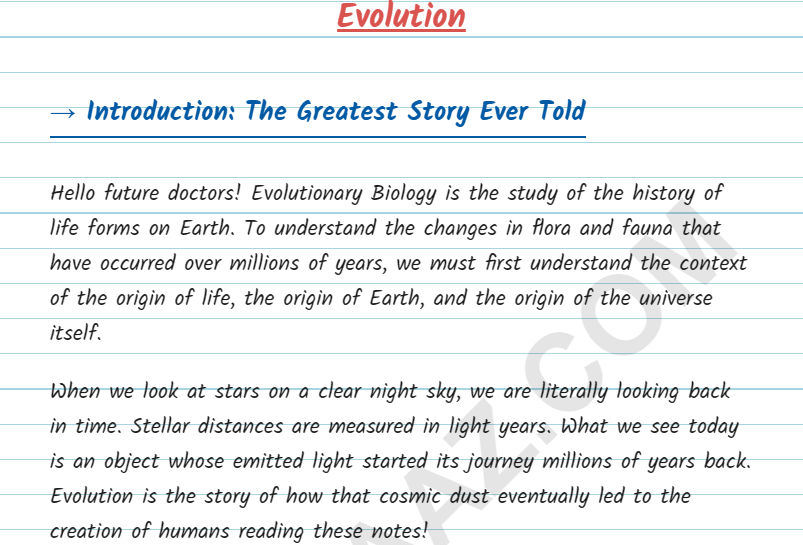
→ Introduction: The Greatest Story Ever Told
Hello future doctors! Evolutionary Biology is the study of the history of life forms on Earth. To understand the changes in flora and fauna that have occurred over millions of years, we must first understand the context of the origin of life, the origin of Earth, and the origin of the universe itself.
When we look at stars on a clear night sky, we are literally looking back in time. Stellar distances are measured in light years. What we see today is an object whose emitted light started its journey millions of years back. Evolution is the story of how that cosmic dust eventually led to the creation of humans reading these notes!
→ Origin of the Universe and Earth
The origin of the universe is explained by the Big Bang Theory. It proposes that the universe originated about 20 billion years ago (BYA) due to a singular, unimaginable, massive explosion. The universe expanded, and hence, the temperature came down. Hydrogen and Helium formed sometime later. The gases condensed under gravitation and formed the galaxies of the present-day universe.
In the solar system of the Milky Way galaxy, Earth was supposed to have been formed about 4.5 billion years ago.
- Early Earth Conditions: There was NO atmosphere on early Earth. Water vapor, methane ($CH_4$), carbon dioxide ($CO_2$), and ammonia ($NH_3$) released from molten mass covered the surface.
- The highly energetic UV rays from the sun broke up water into Hydrogen and Oxygen. The lighter $H_2$ gas escaped.
- Oxygen combined with ammonia and methane to form water, $CO_2$, and others. The ozone layer was formed. As it cooled, the water vapor fell as rain, filling all the depressions and forming oceans.
- Life appeared 500 million years (0.5 billion years) after the formation of Earth, i.e., almost 4 billion years back.
→ Theories of Origin of Life
How did the first living cell come into existence? Several theories were proposed by different thinkers over the centuries:
- 1. Theory of Special Creation: Supported by religious texts. It has three connotations: (i) All living organisms we see today were created as such. (ii) The diversity was always the same since creation and will be the same in the future. (iii) Earth is about 4000 years old. (This theory was strongly challenged during the 19th century based on observations made by Charles Darwin).
- 2. Panspermia (Cosmozoic Theory): Early Greek thinkers thought units of life called 'spores' were transferred to different planets including Earth from outer space. Some astronomers still believe in this today!
- 3. Theory of Spontaneous Generation: It stated that life came out of decaying and rotting matter like straw, mud, etc. Louis Pasteur completely dismissed this theory with his famous Swan-neck flask experiment. He showed that in pre-sterilized flasks, life did not come from killed yeast while in another flask open to air, new living organisms arose from 'killed yeast'.
Chemical Evolution (Oparin and Haldane)
Oparin of Russia and Haldane of England proposed that the first form of life could have come from pre-existing non-living organic molecules (e.g., RNA, protein, etc.) and that formation of life was preceded by chemical evolution, i.e., formation of diverse organic molecules from inorganic constituents.
The Urey-Miller Experiment (1953) - The Proof
American scientist S.L. Miller created conditions similar to early Earth in a laboratory scale.
- He created an electric discharge in a closed flask containing $CH_4$, $H_2$, $NH_3$ and water vapor at 800°C. NEET Trap: Notice there was NO free oxygen ($O_2$) used in the experiment!
- He observed the formation of Amino acids. In similar experiments, others observed the formation of sugars, nitrogen bases, pigment, and fats.
- Analysis of meteorite content also reveals similar compounds, indicating that similar processes are occurring elsewhere in space. With this limited evidence, the first part of the conjectured story, i.e., chemical evolution, was more or less accepted.
The first non-cellular forms of life could have originated 3 billion years ago. They would have been giant molecules (RNA, Protein, Polysaccharides). The first cellular form of life did not possibly originate till about 2000 million years ago.
→ Evidences for Evolution
How do we know evolution actually happened? We have a massive collection of evidence from different branches of biology.
1. Paleontological Evidence (Fossils)
Fossils are remains of hard parts of life-forms found in rocks. Rocks form sediments, and a cross-section of Earth's crust indicates the arrangement of sediments one over the other during the long history of Earth. Different-aged rock sediments contain fossils of different life-forms. The study showed that life-forms varied over time and certain life forms are restricted to certain geological time-spans.
2. Morphological and Anatomical Evidence
This shows the structural similarities and differences between organisms of today and those that existed years ago.
A. Homologous Organs (Divergent Evolution): Organs having the same fundamental structure and origin but performing different functions.
- Animals: Forelimbs of whales, bats, cheetah, and human share similarities in the pattern of bones (humerus, radius, ulna, carpals, metacarpals, and phalanges). They perform different functions (swimming, flying, running, grasping) but have the same anatomical structure.
- Plants: Thorns of Bougainvillea and tendrils of Cucurbita both arise from axillary buds but have different functions (protection vs climbing).
- Homology indicates Common Ancestry. It is a result of Divergent Evolution.
B. Analogous Organs (Convergent Evolution): Organs having different structural patterns but performing the same function.
- Animals: Wings of a butterfly and wings of a bird. They look alike and perform the same function (flying) but are anatomically completely different. The eye of the octopus and the eye of mammals. The flippers of Penguins and Dolphins.
- Plants: Sweet potato (root modification) and potato (stem modification). Both perform the function of storage of food but have different origins.
- Analogy is a result of Convergent Evolution (different structures evolving for the same habitat/function).
3. Biochemical Evidence
Similarities in proteins and genes performing a given function among diverse organisms give clues to common ancestry. Biochemical similarities point to the same shared ancestry as structural similarities do!
→ Darwinian Theory: A Voyage of Discovery
The concept that population organisms have been gradually evolving was strongly backed by observation made by Charles Darwin during a sea voyage in a sail ship called H.M.S. Beagle round the world.
Darwin carefully observed that existing living forms share similarities to varying degrees not only among themselves but also with life forms that existed millions of years ago. Any population has built-in variations in characteristics.
The Essence of Darwinian Theory: Natural Selection
Darwin concluded that those characteristics which enable some individuals to survive better in natural conditions (climate, food, physical factors) would outbreed others that are less-endowed to survive under such natural conditions. He called this fitness.
Therefore, those who are better fit in an environment leave more progeny than others. These will survive more and hence be selected by nature. He called this mechanism Natural Selection and implied it as a mechanism of evolution.
- Branching Descent and Natural Selection are the two key concepts of Darwinian Theory of Evolution.
Darwin wasn't alone. A naturalist named Alfred Wallace, who worked in the Malay Archipelago, had also come to similar conclusions around the same time. In due course of time, apparently new types of organisms are recognizable. All the existing life forms share similarities and share common ancestors. The geological history of Earth closely correlates with the biological history of Earth!
Evidence from Biogeography: Adaptive Radiation
During his journey, Darwin went to the Galapagos Islands. There he observed an amazing diversity of creatures. Of particular interest, small black birds later called Darwin's Finches amazed him.
He realized that there were many varieties of finches in the same island. All the varieties, he conjectured, evolved on the island itself. From the original seed-eating features, many other forms with altered beaks arose, enabling them to become insectivorous and vegetarian finches.
This process of evolution of different species in a given geographical area starting from a point and literally radiating to other areas of geography (habitats) is called Adaptive Radiation.
- Examples of Adaptive Radiation: Darwin's finches and Australian marsupials. A number of marsupials, each different from the other (e.g., Kangaroo, Koala), evolved from an ancestral stock, but all within the Australian island continent.
→ Lamarck's Theory: Use and Disuse of Organs
Before Darwin, a French naturalist named Jean Baptiste de Lamarck proposed that evolution of life forms had occurred but driven by use and disuse of organs.
He gave the example of giraffes. He claimed that giraffes, in an attempt to forage leaves on tall trees, had to adapt by elongation of their necks. As they passed on this acquired character of an elongated neck to succeeding generations, giraffes slowly over the years came to acquire long necks. Today, nobody believes this conjecture, as we know acquired characters are not inherited!
→ Mechanism of Evolution: Hugo de Vries and Mutation
Even if Darwin explained that variations exist, he did not know *how* these variations arose in the first place. The work of Thomas Malthus on populations heavily influenced Darwin. But in the first decade of the twentieth century, Hugo de Vries based on his work on evening primrose (Oenothera lamarckiana) brought forth the idea of mutations.
Mutations are large differences arising suddenly in a population. He believed that it is mutation which causes evolution and not the minor continuous variations that Darwin talked about.
- Darwinian variations: Small, directional, and continuous. Evolution for Darwin was a gradual, slow process.
- Mutations (de Vries): Random, directionless, and discontinuous. de Vries believed mutation caused speciation and called it Saltation (single step large mutation).
→ The Hardy-Weinberg Principle: The Math of Genetics
In a given population, one can find out the frequency of occurrence of alleles of a gene on a locus. This frequency is supposed to remain fixed and even remain the same through generations. Hardy-Weinberg principle stated this mathematically.
This principle says that allele frequencies in a population are stable and is constant from generation to generation. The gene pool (total genes and their alleles in a population) remains a constant. This is called genetic equilibrium. Sum total of all the allelic frequencies is 1.
Let's assume there are two alleles, A and a.
Frequency of allele A = p
Frequency of allele a = q
The frequency of diploid individuals: AA = p², aa = q², Aa = 2pq
The Formula: $p^2 + 2pq + q^2 = 1$
This is a binomial expansion of $(p+q)^2$. When frequency measured differs from expected values, the difference indicates the extent of evolutionary change!
Five Factors Affecting Hardy-Weinberg Equilibrium:
- Gene Migration or Gene Flow: When migration of a section of population to another place occurs, gene frequencies change in the original as well as in the new population.
- Genetic Drift: If the change in gene frequency occurs by pure chance, it is called genetic drift. Sometimes the change in allele frequency is so different in the new sample of population that they become a different species. The original drifted population becomes founders, and the effect is called the Founder effect.
- Mutation: Pre-existing advantageous mutations result in new phenotypes.
- Genetic Recombination: Crossing over during meiosis.
- Natural Selection: Can lead to stabilization, directional change, or disruption.
- Stabilizing Selection: More individuals acquire mean character value. Peak gets higher and narrower (favors average size).
- Directional Selection: More individuals acquire value other than the mean character value. Peak shifts in one direction (e.g., Industrial melanism in moths).
- Disruptive Selection: More individuals acquire peripheral character values at both ends of the distribution curve. Forms two peaks (favors both extremes, eliminates the average).
→ A Brief Account of Evolution
About 2000 million years ago (mya), the first cellular forms of life appeared on earth. Some of these cells had the ability to release $O_2$ (similar to the light reaction in photosynthesis). Slowly single-celled organisms became multi-cellular forms.
- By the time of 500 mya, invertebrates were formed and active.
- Jawless fish probably evolved around 350 mya.
- Sea weeds and few plants existed probably around 320 mya. We are told that the first organisms that invaded land were plants.
The Rise of the Vertebrates
Fish with stout and strong fins could move on land and go back to water. This was about 350 mya. In 1938, a fish caught in South Africa happened to be a Coelacanth (Lobefins) which was thought to be extinct. These animals evolved into the first amphibians that lived on both land and water. There are no specimens of these left with us. However, these were ancestors of modern day frogs and salamanders.
The amphibians evolved into reptiles. They lay thick-shelled eggs which do not dry up in sun unlike those of amphibians. In the next 200 millions years, reptiles of different shapes and sizes dominated on earth.
- Mesozoic Era: The age of reptiles! Giant ferns (pteridophytes) were present but they all fell to form coal deposits slowly. Some of these land reptiles went back into water to evolve into fish-like reptiles probably 200 mya (e.g., Ichthyosaurs).
- The biggest land reptiles were, of course, the dinosaurs. The biggest of them, Tyrannosaurus rex, was about 20 feet in height and had huge fearsome dagger-like teeth.
- About 65 mya, the dinosaurs suddenly disappeared from the earth. We do not know the true reason (maybe climatic changes, or a meteorite). Some of them evolved into birds.
- Cenozoic Era: The age of mammals. The first mammals were like shrews. Mammals were more intelligent in sensing and avoiding danger. When reptiles came down, mammals took over this earth.
→ Origin and Evolution of Man
This is the most crucial part for NEET. Memorize the brain capacities and the chronological order of our ancestors!
1. Dryopithecus & Ramapithecus (15 mya): Primates that were hairy and walked like gorillas and chimpanzees. Ramapithecus was more man-like while Dryopithecus was more ape-like.
2. Australopithecines (2 mya): Lived in East African grasslands. Evidence shows they hunted with stone weapons but essentially ate fruit. They were undoubtedly walking completely upright.
3. Homo habilis: The first human-like being (the handy man). The brain capacities were between 650-800 cc. They probably did not eat meat.
4. Homo erectus (1.5 mya): Fossils discovered in Java in 1891 revealed the next stage. Homo erectus had a large brain around 900 cc. They probably ate meat and were the first to use fire.
5. Neanderthal man: Brain size of 1400 cc. They lived in near east and central Asia between 1,00,000 to 40,000 years back. They used hides to protect their body and buried their dead (showing early signs of culture/religion).
6. Homo sapiens (Modern Man): Arose in Africa and moved across continents and developed into distinct races. During the ice age between 75,000 to 10,000 years ago, modern Homo sapiens arose. Pre-historic cave art developed about 18,000 years ago. Agriculture came around 10,000 years back and human settlements started.
→ Final Wrap Up for Evolutionary Biology
The story of evolution is the ultimate proof that biology is not static; it is incredibly dynamic. To secure top marks in NEET, make absolutely sure you can differentiate between Homologous (Divergent) and Analogous (Convergent) organs with exact examples. Practice the Hardy-Weinberg numericals ($p^2+2pq+q^2$), and memorize the brain capacities of human ancestors (650cc -> 900cc -> 1400cc). You are the product of 4.5 billion years of evolutionary success—act like it and ace this exam!
Mastering Unit VII (Genetics and Evolution) is the ultimate key to unlocking a top medical college seat. While Genetics requires logical problem-solving, Evolution demands a brilliant memory for timelines, theories, and examples. That is exactly why having the Evolution NEET Notes PDF 2026: Download Free Classroom Notes is a massive advantage for every serious aspirant. If you are Looking for the best Evolution NEET Notes PDF 2026? Download free classroom notes covering key theories, NCERT topics, and NEET weightage to boost your score., you have arrived at the ultimate destination.
Many students find the Evolution chapter incredibly dry and confusing due to the overwhelming dates, geological time scales, and various scientist names (like Darwin, Lamarck, and Hugo de Vries). Rankbaaz has simplified this entire chapter into beautifully structured, handwritten-style digital HTML notes that will make your revision faster and much more effective than reading boring textbooks.
Evolution Syllabus Overview & NEET Weightage
Before diving into the PDFs, let's take a quick look at the Evolution syllabus topics prescribed by the NTA for Class 12 Biology. This chapter carries a weightage of about 3 to 4 questions (12 to 16 marks) in the exam.
| S.No | Evolution Chapter Key Topics |
|---|---|
| I | Origin of Life (Oparin-Haldane Theory, Miller's Experiment) |
| II | Evidences for Evolution (Paleontological, Homologous & Analogous Organs) |
| III | Biological Evolution & Theories (Darwinism, Lamarckism, Mutation Theory) |
| IV | Mechanism of Evolution (Hardy-Weinberg Principle) |
| V | A Brief Account of Evolution & Geological Time Scale |
| VI | Origin and Evolution of Man (Dryopithecus to Homo sapiens) |
The NCERT Point of View: Why These Notes Are Perfect
The NTA frames questions directly from the hidden lines of the NCERT book. For instance, the sequence of human evolution (brain capacities like 650-800cc for Homo habilis) or the exact examples of adaptive radiation (Darwin's Finches, Australian Marsupials) are asked exactly as they are written in the textbook.
Our Rankbaaz classroom notes capture the 100% NCERT essence. We have transformed the complex geological time scale paragraphs into easy-to-read chronological flowcharts. The Hardy-Weinberg equilibrium, which confuses thousands of students, is explained with crystal-clear mathematical steps and graphical representations of natural selection (Stabilizing, Directional, and Disruptive).
Benefits of Rankbaaz Evolution Classroom Notes
- Flowcharts & Timelines: Say goodbye to rote learning. We use custom timelines to explain the evolution of plants and animals through Paleozoic, Mesozoic, and Cenozoic eras.
- Handwritten Vibe: The notes are designed to look like premium, top-tier classroom notes. They are highly engaging, reducing eye strain during long study hours.
- High-Yield Highlighting: Examples of convergent and divergent evolution are colour-coded. You will instantly know what is most likely to appear in NEET 2026.
Download Chapter-wise Biology Notes
Evolution is part of the massive Genetics and Evolution unit. Make sure you don't miss out on the other interconnected chapters. Download them directly from the table below:
| Unit VII | Genetics & Evolution Chapters (Click to Download) |
|---|---|
| Chapter 4 | Principles of Inheritance and Variation |
| Chapter 5 | Molecular Basis of Inheritance |
| Chapter 6 | Evolution (Download PDF) |
Expand Your Rank Arsenal: Physics & Chemistry Notes
To cross the 650+ mark, you need a balanced approach. Download our expertly curated notes for Physics and Chemistry to complement your Biology preparation:
| Subject | Important Class 12 Chapters | Download Link |
|---|---|---|
| Physics | Modern Physics, Dual Nature, Atoms & Nuclei, Optics | Download Physics PDFs ➔ |
| Chemistry | Chemical Kinetics, Biomolecules, Polymers (if applicable), Electrochemistry | Download Chemistry PDFs ➔ |
Put Your Knowledge to the Test: Rankbaaz Test Portal
Reading about Darwin's theory is just the beginning. To ensure you don't make silly mistakes in the actual exam, we have built the ultimate tool for you: the Rankbaaz Test Portal.
Once you finish revising the Evolution PDF, log into our Test Portal. It features an advanced algorithm with random question loading, meaning you will never get a predictable pattern. You can select chapter-wise tests specifically for Evolution. The best part? The post-test analysis dashboard will instantly tell you if you are weak in Homologous Organs or the Hardy-Weinberg principle, guiding your revision precisely.
Preparation Tips for NEET Biology (Evolution)
- Memorize Cranial Capacities: Create a small cheat sheet for the brain capacities of human ancestors (e.g., Neanderthal man - 1400cc) and stick it on your wall.
- Understand Analogous vs Homologous: Remember the mnemonic: HD (Homologous = Divergent Evolution) and AC (Analogous = Convergent Evolution).
- Practice Hardy-Weinberg Numericals: Do not just read the formula (p² + 2pq + q² = 1). Practice calculating allele frequencies using our Test Portal to build speed.
FAQs on Evolution NEET Notes (Free PDF)
1. Is Evolution a difficult chapter for NEET?
It can be challenging because it is highly factual and requires remembering a sequence of events and dates. However, using our structured flowcharts and timeline PDFs makes it one of the easiest chapters to score full marks in.
2. How many questions are asked from Evolution in the NEET exam?
You can typically expect 3 to 4 questions from the Evolution chapter every year, contributing to roughly 12 to 16 marks in your Biology section.
3. Does the PDF contain explanations for Miller's Experiment?
Yes. The notes clearly explain the conditions created by Urey and Miller (high temperature, volcanic storms, reducing atmosphere containing CH4, NH3, etc.) and the exact amino acids that were formed.
4. Can I rely solely on these notes without reading NCERT?
These notes are a 100% extract of the NCERT. While they are perfect for fast revision and memorization, we always advise students to read the actual NCERT textbook at least once to understand the language tone used by the NTA.
5. How can I use the Rankbaaz Test Portal for this chapter?
After studying the notes, simply go to the Rankbaaz Test Portal, select the 'Evolution' chapter, and start a mock test. The random question loading will test your true retention, and the post-test analysis will highlight your weak spots.
