
Rankbaaz Header Final
📢 Join Telegram
Join

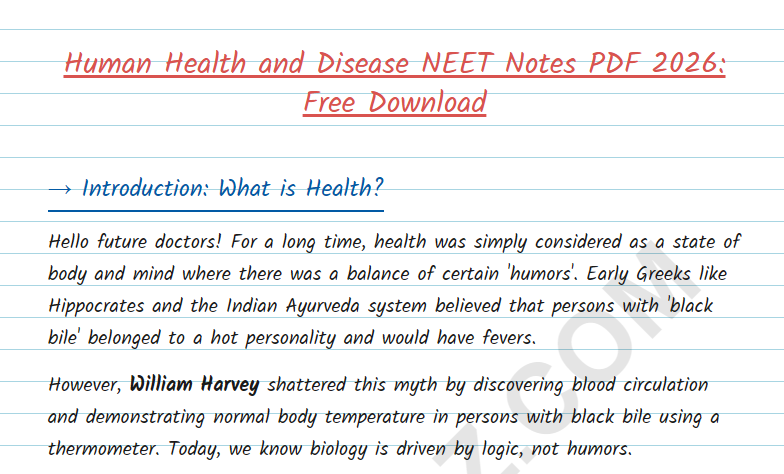
Human Health and Disease NEET Notes PDF 2026: Free Download

→ Introduction: What is Health?

Hello future doctors! For a long time, health was simply considered as a state of body and mind where there was a balance of certain 'humors'. Early Greeks like Hippocrates and the Indian Ayurveda system believed that persons with 'black bile' belonged to a hot personality and would have fevers.

However, William Harvey shattered this myth by discovering blood circulation and demonstrating normal body temperature in persons with black bile using a thermometer. Today, we know biology is driven by logic, not humors.

Definition of Health: Health is not just the absence of disease or physical fitness. It is defined as a state of complete physical, mental, and social well-being. When people are healthy, they are more efficient at work, which increases productivity and brings economic prosperity.

Factors Affecting Health:

  • Genetic Disorders: Deficiencies with which a child is born and defects inherited from parents.
  • Infections: Caused by pathogens like bacteria, viruses, fungi, etc.
  • Lifestyle: Food and water we take, rest and exercise we give our bodies, and habits we have or lack.

→ Common Diseases in Humans

A wide range of organisms belonging to bacteria, viruses, fungi, protozoans, helminths, etc., can cause diseases in man. Such disease-causing organisms are called Pathogens. All parasites are pathogens as they cause harm to the host by living in (or on) them. Let's break down the most important ones for NEET.

1. Bacterial Diseases

NEET VIP Concept: Typhoid & Mary Mallon

Typhoid: Caused by pathogenic bacterium Salmonella typhi. These pathogens generally enter the small intestine through food and water contaminated with them and migrate to other organs through blood.

  • Symptoms: Sustained high fever (39°C to 40°C), weakness, stomach pain, constipation, headache, and loss of appetite. Intestinal perforation and death may occur in severe cases.
  • Diagnostic Test: Widal Test.
  • Fun Fact: Mary Mallon, nicknamed "Typhoid Mary", was a cook by profession and a typhoid carrier who continued to spread the disease through the food she prepared for years!

Pneumonia: Caused by bacteria like Streptococcus pneumoniae and Haemophilus influenzae. It infects the alveoli (air-filled sacs) of the lungs. The alveoli get filled with fluid leading to severe problems in respiration.
Symptoms: Fever, chills, cough, and headache. In severe cases, the lips and fingernails may turn grey to bluish in color. Transmission is via inhaling droplets/aerosols released by an infected person.

2. Viral Diseases

Common Cold: Caused by a group of viruses called Rhinoviruses. They infect the nose and respiratory passage, but NOT the lungs (This is the key difference between common cold and pneumonia!). It lasts for 3-7 days.

3. Protozoan Diseases

Malaria: Caused by Plasmodium (a tiny protozoan). Different species (P. vivax, P. malariae, and P. falciparum) cause different types of malaria. Malignant malaria caused by P. falciparum is the most serious and can be fatal.

The Plasmodium Life Cycle (Digenetic):
  • Primary Host (Human): Plasmodium enters the human body as sporozoites (infectious form) through the bite of an infected female Anopheles mosquito. The parasites initially multiply within the Liver Cells and then attack the Red Blood Cells (RBCs), causing their rupture.
  • The rupture of RBCs releases a toxic substance called Haemozoin, which is responsible for the chill and high fever recurring every 3 to 4 days.
  • Secondary Host (Mosquito): Female Anopheles mosquito bites an infected person and takes up gametocytes with the blood meal. Fertilization and development take place inside the mosquito's intestine. The sporozoites are stored in its salivary glands, ready to infect a new human.

Amoebiasis (Amoebic Dysentery): Caused by Entamoeba histolytica, a protozoan parasite in the large intestine.
Symptoms: Constipation, abdominal pain, and stools with excess mucous and blood clots. Houseflies act as mechanical carriers, transmitting the parasite from feces of an infected person to food.

4. Helminthic Diseases (Worms)

Ascariasis: Caused by Ascaris (the common roundworm), an intestinal parasite. Symptoms include internal bleeding, muscular pain, fever, anemia, and blockage of the intestinal passage.

Filariasis (Elephantiasis): Caused by Wuchereria (W. bancrofti and W. malayi). These filarial worms cause a slowly developing chronic inflammation of the organs in which they live for many years, usually the lymphatic vessels of the lower limbs. The genital organs are also often affected, resulting in gross deformities. Pathogens are transmitted through the bite of female mosquito vectors (Culex).

5. Fungal Diseases

Ringworms: Caused by fungi belonging to the genera Microsporum, Trichophyton, and Epidermophyton. They are responsible for ringworms, one of the most common infectious diseases in man.
Symptoms: Appearance of dry, scaly lesions on various parts of the body such as skin, nails, and scalp, accompanied by intense itching. Heat and moisture help these fungi to grow, which makes them thrive in skin folds such as those in the groin or between the toes.

→ Immunity: Our Defense System

Every day we are exposed to large numbers of infectious agents. However, only a few of these exposures result in disease. Why? Because our body is able to defend itself from most of these foreign agents. This overall ability of the host to fight the disease-causing organisms, conferred by the immune system, is called Immunity.

Immunity is of two types: (1) Innate immunity and (2) Acquired immunity.

1. Innate Immunity

Innate immunity is non-specific type of defense, that is present strictly at the time of birth. This is accomplished by providing different types of barriers:

  • Physical barriers: Skin on our body is the main barrier. Mucus coating of the epithelium lining the respiratory, gastrointestinal, and urogenital tracts also helps trap microbes.
  • Physiological barriers: Acid in the stomach, saliva in the mouth, tears from eyes—all prevent microbial growth.
  • Cellular barriers: Certain types of leukocytes (WBC) of our body like Polymorpho-nuclear Leukocytes (PMNL-neutrophils), monocytes, and natural killer (NK) cells in the blood, as well as macrophages in tissues, can phagocytose (eat) and destroy microbes.
  • Cytokine barriers: Virus-infected cells secrete proteins called Interferons which protect non-infected cells from further viral infection.

2. Acquired Immunity

Acquired immunity is pathogen-specific. It is characterized by memory. When our body encounters a pathogen for the first time, it produces a response called the primary response (which is of low intensity).
Subsequent encounters with the SAME pathogen elicit a highly intensified secondary (anamnestic) response. This is because our body appears to have 'memory' of the first encounter.

NEET Concept: B-Cells and T-Cells

The primary and secondary immune responses are carried out with the help of two special types of lymphocytes present in our blood:

  • B-lymphocytes: They produce an army of proteins (Antibodies) in response to pathogens into our blood to fight with them. Each antibody molecule has four peptide chains (two light chains and two heavy chains, represented as $H_2L_2$). Because antibodies are found in the blood, this response is also called Humoral Immune Response.
  • T-lymphocytes: They themselves do NOT secrete antibodies but help B-cells produce them. T-cells also mediate the Cell-Mediated Immunity (CMI). Very importantly, the CMI is responsible for the graft rejection during organ transplantations. The body is able to differentiate 'self' and 'non-self' organs.

Active vs Passive Immunity

  • Active Immunity: When a host is exposed to antigens, antibodies are produced in the host body. This is slow and takes time. (e.g., getting infected by a microbe or getting a vaccination).
  • Passive Immunity: When ready-made antibodies are directly given to protect the body against foreign agents.
    Examples: The yellowish fluid Colostrum secreted by the mother during the initial days of lactation has abundant IgA antibodies to protect the infant. Preformed antibodies given during a snake bite or tetanus injection are also classic examples of passive immunity.

→ Allergies & Autoimmunity

Allergies: The exaggerated response of the immune system to certain antigens present in the environment is called allergy. The substances to which such an immune response is produced are called allergens (e.g., dust, pollen, animal dander).
The antibodies produced to these are of IgE type. Symptoms (sneezing, watery eyes, running nose) are due to the release of chemicals like histamine and serotonin from the mast cells. Drugs like anti-histamines, adrenaline, and steroids quickly reduce the symptoms.

Autoimmunity: Sometimes, due to genetic and other unknown reasons, the body attacks its own cells. This results in damage to the body and is called an autoimmune disease. Rheumatoid arthritis is a common and severe example of an autoimmune disease in human society.

→ Immune System in the Body

The human immune system consists of lymphoid organs, tissues, cells, and soluble molecules like antibodies.

NEET Trap: Lymphoid Organs
  • Primary Lymphoid Organs: Bone marrow and Thymus. These are the organs where immature lymphocytes differentiate into antigen-sensitive lymphocytes.
    *Bone marrow is the main organ where all blood cells including lymphocytes are produced. The Thymus is quite large at the time of birth but keeps reducing in size with age.*
  • Secondary Lymphoid Organs: Spleen, lymph nodes, tonsils, Peyer’s patches of small intestine, and appendix. After maturation, lymphocytes migrate here. These provide the sites for interaction of lymphocytes with the antigen.
  • MALT (Mucosa-Associated Lymphoid Tissue): Located within the lining of major tracts (respiratory, digestive, urogenital). It constitutes about 50% of the lymphoid tissue in the human body!

→ AIDS (Acquired Immuno Deficiency Syndrome)

AIDS was first reported in 1981. It is caused by the Human Immunodeficiency Virus (HIV), a member of a group of viruses called retroviruses, which have an envelope enclosing the RNA genome.

Mechanism of HIV Infection:

  • After getting into the body of the person, the virus enters into macrophages where RNA genome of the virus replicates to form viral DNA with the help of the enzyme reverse transcriptase.
  • This viral DNA gets incorporated into host cell's DNA and directs the infected cells to produce virus particles. The macrophages continue to produce viruses and in this way act like an HIV factory.
  • Simultaneously, HIV enters into Helper T-lymphocytes ($T_H$), replicates, and produces progeny viruses. The progeny viruses released in the blood attack other Helper T-lymphocytes. This is repeated, leading to a progressive and massive decrease in the number of Helper T-cells in the body.
  • Due to this severe decrease, the person starts suffering from infections (like Mycobacterium, Toxoplasma, fungi) that could have been easily overcome otherwise.

A widely used diagnostic test for AIDS is ELISA (Enzyme Linked Immuno-Sorbent Assay). Treatment with anti-retroviral drugs is only partially effective; they can only prolong the life of the patient, but cannot prevent death.

→ Cancer: The Cell Cycle Gone Rogue

Cancer is one of the most dreaded diseases of human beings. In our body, cell growth and differentiation are highly controlled and regulated. In cancer cells, there is a breakdown of these regulatory mechanisms.

Normal cells show a property called Contact Inhibition by virtue of which contact with other cells inhibits their uncontrolled growth. Cancer cells appear to have completely lost this property. As a result of this, cancerous cells just continue to divide giving rise to masses of cells called tumors.

Types of Tumors:

  • Benign Tumors: Normally remain confined to their original location and do not spread to other parts of the body. They cause little damage.
  • Malignant Tumors: Mass of proliferating cells called neoplastic or tumor cells. These cells grow very rapidly, invading and damaging the surrounding normal tissues. Cells sloughed from such tumors reach distant sites through blood, and wherever they get lodged in the body, they start a new tumor there. This most feared property of malignant tumors is called Metastasis.

Causes of Cancer: Transformation of normal cells into cancerous cells may be induced by physical, chemical, or biological agents called Carcinogens.
Physical: X-rays, gamma rays, and UV rays (cause DNA damage).
Chemical: Tobacco smoke (lung cancer).
Biological: Cancer-causing viruses are called oncogenic viruses. Furthermore, several genes called cellular oncogenes (c-onc) or proto-oncogenes have been identified in normal cells which, when activated under certain conditions, could lead to oncogenic transformation.

→ Drugs and Alcohol Abuse

The statistics show that use of drugs and alcohol has been on the rise, especially among the youth. Proper education and guidance are required. The drugs commonly abused are opioids, cannabinoids, and coca alkaloids. Majority of these are obtained from flowering plants, while some are obtained from fungi.

NEET Priority: The Major Drug Categories

1. Opioids: These drugs bind to specific opioid receptors in our central nervous system and gastrointestinal tract.
Heroin (commonly called smack) is chemically diacetylmorphine. It is a white, odorless, bitter crystalline compound. It is obtained by acetylation of morphine, which is extracted from the latex of the poppy plant Papaver somniferum. Heroin is a depressant and slows down body functions.

2. Cannabinoids: Interacts with cannabinoid receptors present principally in the brain. Natural cannabinoids are obtained from the inflorescences of the plant Cannabis sativa.
Marijuana, hashish, charas, and ganja are produced from it. These are known for their effects on the cardiovascular system of the body.

3. Coca Alkaloid (Cocaine): Obtained from the coca plant Erythroxylum coca, native to South America. It interferes with the transport of the neuro-transmitter Dopamine. Cocaine, commonly called coke or crack, is usually snorted. It has a potent stimulating action on the CNS, producing a sense of extreme euphoria and increased energy. Excessive dosage causes hallucinations.

Tobacco: Has been used by humans for more than 400 years. It contains a large number of chemical substances including nicotine, an alkaloid. Nicotine stimulates the adrenal gland to release adrenaline and nor-adrenaline into blood circulation, raising blood pressure and heart rate. Smoking is associated with an increased incidence of cancers of lung, urinary bladder, and throat.

→ Final Wrap Up

"Human Health and Diseases" requires you to be exact with your factual memory. Memorize the causative agents (pathogens) of the specific diseases, the difference between active and passive immunity (with colostrum as a prime example), the concept of contact inhibition in cancer, and the plant sources of the major abused drugs. Revising these notes thoroughly will make sure you easily bag the 12-16 marks this chapter offers in NEET. Good luck!

Securing a top rank in the medical entrance exam demands absolute clarity in high-weightage chapters. One such crucial chapter is from Class 12 Unit VIII. Having the right Human Health and Disease NEET Notes PDF 2026: Free Download can drastically change your preparation trajectory. If you are Looking for Human Health and Disease NEET Notes PDF 2026? Download free classroom revision notes covering immunity, diseases, and NCERT concepts to ace your exam., you have landed on the most reliable platform.

This chapter bridges the gap between basic biology and real-world medicine. It introduces you to the core of what you will study in your MBBS—pathogens, the human immune system, deadly diseases like AIDS and Cancer, and the devastating impact of drug abuse. Because of its vast theoretical nature, reading it repeatedly from bulky textbooks is highly inefficient. Rankbaaz has condensed this massive information into premium, handwritten-style digital notes that make memorization effortless.
Human Health and Disease NEET Notes PDF 2026 Download

Importance of the Chapter & NEET Weightage

The "Human Health and Disease" chapter is a goldmine for NEET aspirants. Historically, the National Testing Agency (NTA) asks around 3 to 4 questions (12 to 16 marks) from this specific chapter every year. The questions are usually a mix of direct factual data (like the causative agent of Typhoid) and conceptual logic (like the difference between Active and Passive Immunity).

Key areas covered in these notes include:

  • Common Infectious Diseases in Humans (Bacterial, Viral, Fungal, Protozoan, Helminthic).
  • Immunity (Innate, Acquired, Active, Passive, Autoimmunity, Immune System in the Body).
  • AIDS (Transmission, Life Cycle of HIV, Prevention).
  • Cancer (Causes, Detection, Diagnosis, and Treatment).
  • Drugs and Alcohol Abuse (Opioids, Cannabinoids, Coca Alkaloids, Adolescence, and Addiction).

The NCERT Point of View: Why Our Notes Stand Out

The NEET Biology paper is synonymous with the NCERT textbook. Every line, diagram, and table is a potential multiple-choice question. Here is how our notes leverage the NCERT point of view:

  • Perfect Tabular Formats: We have converted confusing paragraphs about diseases into a simple table: Disease Name ➔ Causative Organism ➔ Mode of Transmission ➔ Symptoms ➔ Diagnostic Test (e.g., Widal test for Typhoid).
  • Diagrammatic Precision: The structure of an antibody molecule (H2L2) and the complex Life Cycle of Plasmodium (Malarial Parasite) are explained using high-definition, labeled flowcharts directly extracted from NCERT concepts.
  • Scientific Names Highlighted: NTA loves asking the scientific names of plants from which drugs are extracted. We have prominently highlighted Papaver somniferum (Opioids), Cannabis sativa (Cannabinoids), and Erythroxylum coca (Cocaine) to ensure they stick in your memory.

Download Unit VIII Biology Notes (Chapter-wise PDF)

Biology in Human Welfare (Unit VIII) consists of two highly scoring chapters. Ensure you download both PDFs to complete your unit revision effectively:

Chapter No. Biology in Human Welfare Chapters (Click to Download)
Chapter 7 Human Health and Disease (Download PDF)
(Immunity, AIDS, Cancer, Drugs, Common Diseases)
Chapter 8 Microbes in Human Welfare
(Household Products, Industrial Products, Sewage Treatment, Biogas, Biocontrol Agents)

Boost Your Overall Score: Physics & Chemistry Notes

To secure a seat in top AIIMS or state medical colleges, you must conquer Physics and Chemistry as well. Download our interconnected, premium study materials below:

Subject High-Weightage Class 12 Chapters Download Link
Physics Electromagnetic Waves, Ray Optics, Wave Optics, Dual Nature of Radiation Download Physics PDFs ➔
Chemistry Haloalkanes & Haloarenes, Alcohols Phenols Ethers, Amines, Biomolecules Download Chemistry PDFs ➔

Test Your Preparation: Rankbaaz Test Portal

Have you finished memorizing the differences between T-lymphocytes and B-lymphocytes? Don't just assume you remember it—test it! We highly recommend using the highly advanced Rankbaaz Test Portal immediately after reading these notes.

Our portal features random question loading, which means you get a fresh, unpredictable set of strictly NCERT-based MCQs every time you attempt a chapter-wise test for "Human Health and Disease". Furthermore, our post-test analysis dashboard will explicitly tell you if you are losing marks in the "Immunity" section or the "Drugs & Alcohol" section, helping you revisit the exact page in our notes to fix your weak concepts.

Expert Preparation Tips for this Chapter

  • Focus on Immunity Differences: Create a mental map separating Innate vs. Acquired Immunity, and Active vs. Passive Immunity. NTA frequently asks statement-based questions on these topics.
  • Master the Plasmodium Cycle: Remember which stage of the malarial parasite is infective to humans (Sporozoites) and which stage is picked up by the female Anopheles mosquito (Gametocytes).
  • Drug Receptors: Pay close attention to where the receptors for different drugs are located in the human body (e.g., Opioid receptors are in the Central Nervous System and Gastrointestinal tract).

FAQs on Human Health and Disease NEET Notes

1. Is 'Human Health and Disease' a difficult chapter to memorize?

It contains a lot of factual information regarding pathogens and drugs, which can be tough. However, using our structured tables and flowcharts drastically reduces memorization time and makes revision extremely easy.

2. How many marks does this chapter carry in the NEET Exam?

You can expect around 3 to 4 questions from this chapter, which equals 12 to 16 marks. It is one of the most critical chapters in Class 12 Biology.

3. Are the diagrams in this chapter important for NEET?

Yes, absolutely. The diagram of the antibody molecule, the life cycle of HIV (Retrovirus), and the chemical structures of Morphine and Cannabinoids are extremely important for image-based questions.

4. Will these notes help me prepare for my Class 12 Board exams?

Yes. Although highly optimized with objective facts for NEET 2026, the systematic and detailed explanations of concepts like Cancer and Immunity make these notes perfect for framing subjective answers in your Board exams.

5. How can I use the Rankbaaz Test Portal effectively?

After reading the PDF once, open the Rankbaaz Test Portal, select this specific chapter, and attempt a 50 MCQ test. Check your post-test analysis, identify the questions you got wrong (e.g., matching diseases with pathogens), and re-read that specific table from our notes.


×
NEET Final Prep
⚠️ May 3rd Reality Check

Will you clear NEET? Test your exact level this Sunday.

Most students ignore this All-India Mock and regret it. Get your Instant AIR Prediction before the final exam.

Unlock Free Paper 🔓
Telegram

Join Our Telegram Channel

Get latest Free Notes & updates instantly.

Join Now
×

Rankbaaz Login

Access your dashboard

Continue with Google
OR EMAIL