
CBSE Class 11 Syllabus 2026-27 PDF Download (All Subjects) – Science, Commerce & Arts
CBSE Class 11 Syllabus 2026-27: Official PDF & Subject-by-Subject Guide
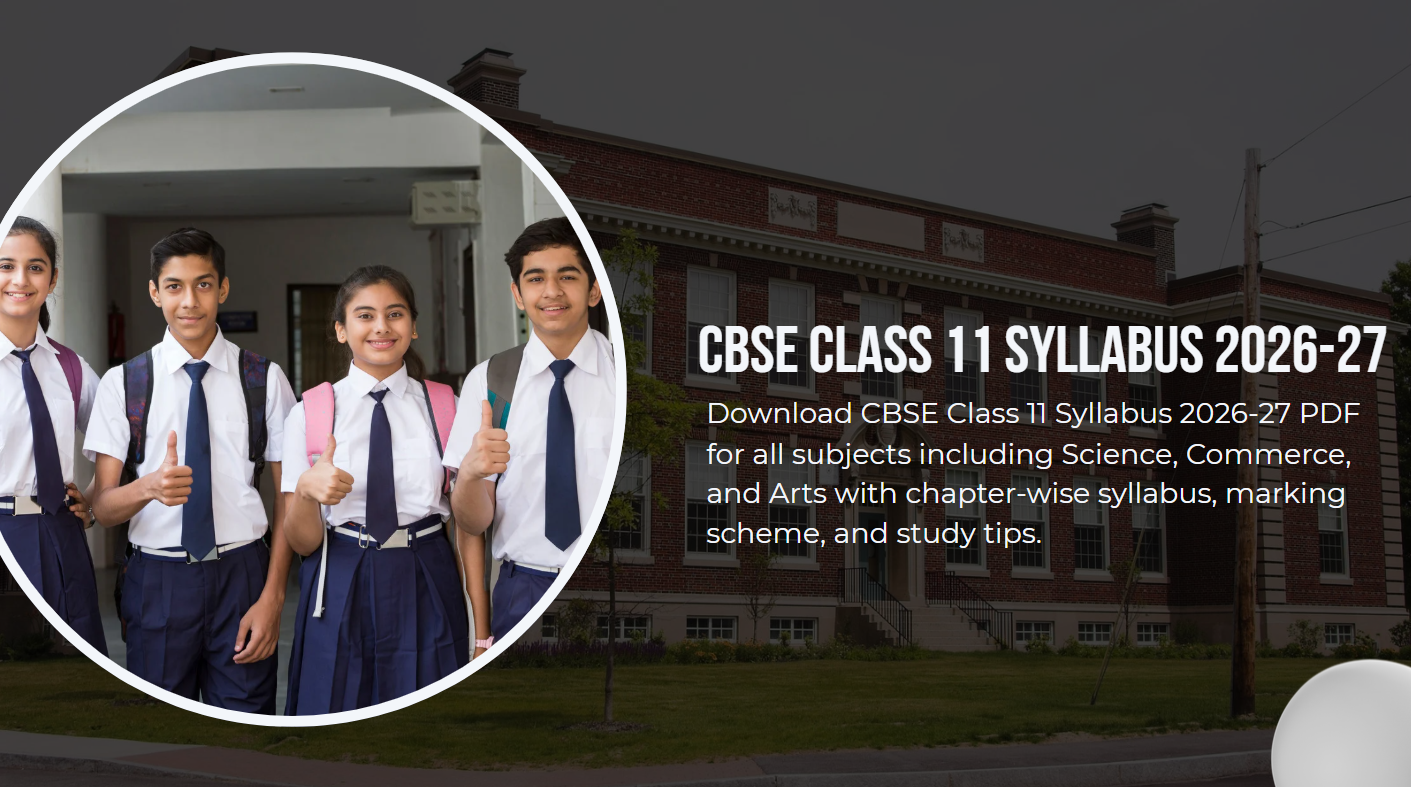
Moving from Class 10 to 11 can feel like jumping into a new world: tougher concepts, new subjects and terms, and suddenly everyone’s talking about boards and entrance exams. CBSE has just released the Class 11 syllabus for 2026-27 (see Circular Acad-14/2026). This means you now have the official list of exactly what to study – and what not to worry about. But reading a long PDF is hard on your own.
This guide breaks it all down for you in plain English. We’ll cover each stream (Science, Commerce, Arts), highlight the key units and marking schemes, and share smart tips from our 10+ years of teaching CBSE students. By the end, you’ll know where to focus and how to use the syllabus to study efficiently. (Spoiler: It’s not just about downloading PDFs – it’s about understanding why each topic matters.)
- Why Class 11 Syllabus Matters
- New Changes for 2026-27
- Stream-wise Subjects & Chapters (Science, Commerce, Humanities/Arts)
- CBSE Exam Pattern & Marking Scheme
- How to Use the Syllabus to Plan Your Study
- Common Mistakes to Avoid
- Internal Resources (NEET Toppers Notes)
- FAQs
- Conclusion
Why Class 11 Syllabus Matters
You might be thinking, “It’s just Class 11 – boards only happen in 12th, right?” Not quite. Class 11 sets the foundation for everything ahead. If you miss basics now, Class 12 and entrance exams become much harder. As one Delhi coaching teacher told me: “Students who finish Class 11 concepts in June breeze through Class 12; those who cram in March of 12th struggle.”
CBSE’s Class 11 syllabus 2026-27 is designed with the new National Curriculum Framework (NCF 2023) in mind. That means more application and competency-based questions. Topics build on each other. For example, a clear grasp of Class 11 Physics units like Laws of Motion and Work-Energy directly affects how well you handle Rotational Motion and Gravitation later. Skipping derivations in Physics Unit 1 might make Unit 5 (Thermodynamics) a nightmare. Science students: make sure to understand every Class 11 concept, because JEE/NEET rely heavily on them. Commerce students: Class 11 Accountancy lays the groundwork for financial statements in Class 12. Humanities: Class 11 History and Political Science introduce key ideas you'll analyze more deeply in Class 12.
In short, the CBSE Class 11 syllabus is your roadmap. Read it carefully so you know what your teachers expect and what to include in your notes. It tells you exactly which chapters to learn. For busy students like you, that clarity saves tons of time and stress later.
New Changes for 2026-27
The 2026-27 session brings a few important changes:
- Single final exam: CBSE has officially removed term-end exams and will hold one comprehensive board exam in March 2027 for each subject. That means you need to cover the whole syllabus in one go.
- Exam duration and language: Main subjects (typically 80-mark papers) have a 3-hour exam. Any 50-mark papers (often language electives or skill subjects) get 90 minutes. Question papers are in English or Hindi, but you cannot mix languages in your answers.
- Competency focus: Questions will test understanding, not just memorisation. Expect MCQs and case-based questions (as per the new CBSE policy).
- Official source: The CBSE circular confirmed the new curriculum’s release on April 1, 2026. You can download the official syllabus PDFs for all subjects from the CBSE Academic website (Curriculum 2026-27 tab).
Knowing these updates matters. For example, some students ask, “Do we still have periodic tests?” Yes, you’ll still do internal assessments (often 20 marks), but there’s no separate term board exam. You now face one big exam at year-end. Plan accordingly.
Stream-wise Subjects & Key Chapters
CBSE Class 11 lets you choose a stream, but even within a stream there are optional subjects. Here are the core subjects for each stream, and the major chapters/topics you must know. (I’ve included a few teacher tips and examples after each list.)
Science (PCM or PCB):
- Physics: Physical World & Measurement, Kinematics, Laws of Motion, Work-Energy-Power, Rotational Motion, Gravitation, Thermodynamics, Kinetic Theory, Oscillations & Waves.
- Chemistry: Basic Concepts, Atomic Structure, Periodic Table, Chemical Bonding, Thermodynamics, Equilibrium, Redox Reactions, Organic Foundations (basic principles, alkanes & alkenes).
- Biology (if chosen): Diversity of Life, Plant Physiology, Human Physiology, Cell Structure & Genetics, Plant/Animal Kingdom, Reproduction.
- Mathematics: Sets & Functions, Algebra (complex numbers, sequences), Coordinate Geometry, Calculus (limits & derivatives), Statistics & Probability.
- Computer Science/IP: Basics of programming, C++/Python fundamentals (if opted).
Commerce:
- Accountancy: Theoretical framework (GAAPs, accounting process), Preparing ledgers & trial balance, Final accounts of sole proprietorship, Introduction to GST.
- Business Studies: Nature & purpose of business, Forms of organizations, Business services, Emerging modes of business (e-commerce, digitization), Social responsibilities and business ethics.
- Economics: Statistics (collection, graphical presentation, central tendency), Microeconomics (demand-supply, consumer behavior, market equilibrium, elasticity).
- Mathematics (or Applied Maths): Same as Science maths topics if chosen.
Humanities/Arts:
- History: Early societies to Medieval India – e.g. Indus Valley, Vedic Age, Mauryan Empire, Bhakti movement (the overview topics).
- Political Science: Constitution (making of Indian Constitution), Rights and duties of citizens, Executive-Legislature-Judiciary structure, Federalism, Local Government.
- Geography: Physical Geography fundamentals (geomorphology, climate, vegetation), India Physical Environment (structure, climate, resources).
- Psychology: Basic psychology (learning, memory, motivation), human development stages.
- Sociology: Society & culture (social institutions, social change, social structure in India).
(Bullet lists above highlight key units; every topic listed in the official syllabus is important – for full details, download the PDF. Our point here is to focus on main chapters. For example, I always tell students: Kinematics and Laws of Motion in Physics are must-do chapters, because questions in Boards/NEET often come from them. If you’re a Biology student, note that “Cell Structure & Genetics” forms the basis of many higher-level questions in Class 12.)
Science Stream (PCB/PCM)
Physics: 11th Physics covers a lot of groundwork. Measurements & Units (Ch 1) might feel basic, but it introduces dimensions and errors – skip this and Unit 5 (Thermal Physics) will confuse you. Kinematics & Laws of Motion (Ch 2-5) are crucial: I’ve seen several students fix low scores only after mastering vector motion in 11th. Practice drawing FBDs for Laws of Motion (Chapter 5) – when boards ask “identify forces”, that FBD practice pays off. Remember to learn SI units (mistaking Nm vs N·m cost top students marks!).
Internal Resource: For revision, try our Physics NEET Toppers Notes, which summarize formulas and concepts chapter-wise in a crisp way.
Chemistry: Focus on understanding Atomic Structure (electronic configuration) and Periodic Trends – these recur in Class 12 inorganic chemistry. Chemical Bonding (Chapter on molecules and bond types) and Thermodynamics/Equilibria (Ch 6-7) require clear concepts, not rote. Work through NCERT examples for Thermodynamics formulas. I’ve seen students confuse units or ignore sign in ΔE, leading to silly mistakes in boards.
Internal Resource: Our Chemistry NEET Toppers Notes can help reinforce core reactions and formulas.
Biology: (if you took it) Class 11 Bio lays the foundations: Diversification (Ch 1-3), Biological Classification, Plant & Human Physiology. Don’t rush past Cell Structure – it’s short but critical for genetics later. I always tell students to draw diagrams (like cell, biomolecules) neatly; they help in retaining details.
Internal Resource: Check our Biology NEET Toppers Notes for chapter summaries and quick MCQs.
Mathematics: Class 11 Maths is heavy on theory, but each topic links to Class 12. Sets & Functions (Unit I) is used everywhere; Algebra (Complex nos, progressions) is base for calculus; Coordinate Geometry (straight lines, circles) comes up often; Calculus (limits/derivatives) is the first step to advanced calculus next year; Probability & Statistics is scoring if you practice. Work more on your weak areas: for instance, weak in coordinate geometry? I’ve seen students avert big marks loss simply by reviewing line equations every week.
Commerce Stream
Accountancy: Core chapters are Theoretical Framework (basic accounting terms), Recording Transactions (journal, ledger, trial balance), and Financial Statements (final accounts). Practice by preparing single-entity final accounts – many students lose marks by omitting closing entries. GST fundamentals may appear; ask your teacher for updates since 2026-27 saw new GST rules.
Business Studies: Important topics include Forms of Organizations (sole proprietorship, partnership) and Sources of Business Finance. Also Emerging Business (like e-business, outsourcing) is a Class 11 focus. If you can, relate them to India-specific examples (like “flipkart as e-commerce example”). I counsel students to connect theory to current events (e.g. corporate social responsibility in big companies).
Economics: Statistics for Economics (tools like average, index numbers) and Basic Microeconomics (demand/supply, market equilibrium) are key. Draw graphs for supply/demand to understand elasticity – those diagrams save lives in exams.
Mathematics: If you choose Maths here, it’s the same Class 11 Maths as above – see Science notes.
Humanities/Arts Stream
Political Science: Cover the Making of India’s Constitution, rights/duties, and Citizenship thoroughly. These form the core. For example, PWD (parts of Indian Constitution) and fundamental duties are common questions.
History: The syllabus typically includes chapters on Early Civilizations, Medieval Empires (e.g. Delhi Sultanate), and Colonial era. Understand timelines and cause-effect (why Emperors built structures, etc.). Creating timelines in notes helped my students visualize chronology.
Geography: NCERT is key: Physical Geography and India's physical divisions are usually asked. Maps and diagrams are your friends here (e.g., draw the Monsoon system).
Psychology/Sociology: Focus on definitions and famous studies (since Class 11 often covers introduction to major experiments or sociologists).
CBSE Exam Pattern & Marking Scheme
Each subject’s exam pattern can differ, so be clear:
- Duration: Most 80-mark papers are 3 hours. Some subjects (like skill electives) have 50-mark papers with 90 minutes. Start preparing for full-length papers as if one board exam in March.
- Language of Paper: Papers are set in English and Hindi (or any regional language for languages). Important: You cannot answer partly in English and partly in Hindi – pick one medium for each subject.
- Marks Distribution: Generally, major subjects have an 80/20 split (80 for theory, 20 for internal assessment). For example, Math, Accounts, Business, and languages usually follow 80+20. Science subjects vary: Physics, Chemistry, Biology have practical/lab components, so it’s often 70 for written theory and 30 for practical/viva. Physics Syllabus shows 23, 24, etc., per unit and 20 marks Practical. English Core (Class 11) has 80 theory + 20 internal (listening, project). We recommend checking the official CBSE site for exact patterns of your subjects.
- Question Types: Expect a mix – objective (MCQs), short answers, long answers. Modern CBSE papers give at least ~20% weight to case-based/competency questions (even in Class 11). Insider tip: Practice with latest CBSE sample papers to see this style.
| Subject | Theory Marks | Practical/Other |
|---|---|---|
| Physics | 70 | 30 (Practicals) |
| Chemistry | 70 | 30 (Practicals) |
| Biology | 70 | 30 (Practicals) |
| Mathematics | 80 | 20 (Internal) |
| English Core | 80 | 20 (Internal) |
| Accountancy | 80 | 20 (Project/Int) |
| Business Studies | 80 | 20 (Project/Int) |
| Economics | 80 | 20 (Internal) |
| Others (Gen. Adv.) | 80 | 20 (Internal) |
(This table shows common distributions; always verify via official syllabus PDF for subjects like Computer Science or fine arts, as they may differ.)
How to Use the Syllabus to Plan Your Study
Having the syllabus PDF is just step one. Use it to plan your entire study year:
- Break it Down: List all chapters for each subject (as above). Divide them into easy, moderate, and difficult based on your comfort. I advise students to tackle the hardest topics first when energy is highest. For example, if you find Electrostatics (Physics) tough, start your study cycle with it, then move to easier revision later.
- Make a Weekly Plan: Assign 2–3 topics per week per subject, leaving room for revision. Balance is key: don’t study all Science in one day and neglect Hindi or Maths for a week. For instance, in a weekday, do Physics (1 chapter), 1 hours, then switch to Business studies (1 chapter), and Maths problem practice. This variety keeps you fresh.
- Active Notes: The syllabus gives topics; your notes make them stick. Don’t copy textbook paragraphs. Write bullet-point notes in your own words, list formulas in boxes, and draw key diagrams. When I taught Physics, I encouraged students to create a single “formula sheet” from the syllabus topics. That sheet became invaluable for last-minute revision.
- Regular Revision: Don’t wait till March to glance at Class 11 work. Revise each subject weekly. A simple trick: after covering a chapter, schedule a quick review 3 days later and again 1 week later. I’ve seen Class 11 students halve their board anxiety just by this repetition – it moves information from short-term to long-term memory.
- Link to Previous Year Papers: Use Class 11 past CBSE papers (if available) or Class 12 papers on overlapping topics. Our NEET Toppers Notes for each subject have many MCQs and short-answer practice drawn from past exams. Solve a few every day from topics you’ve learned.
- One Subject at a Time: Multitasking is a myth for studying. Focus on finishing a topic chapter-by-chapter. For example, read the Class 11 Physics chapter fully first, then solve its questions. Many students make the mistake of “reading then sleeping on it.” Always follow each chapter read with active problem-solving (or teaching the concept to someone).
- NCERT First: Especially for theoretical subjects (Science, Maths, Socials), NCERT is your bible. CBSE often takes questions directly from NCERT examples or exercises. As one success story from Kota told me: “I solved all NCERT end-of-chapter questions in Class 11, and it paid off 3x in boards and NEET.” After NCERT, you can look at reference books or your coaching material for extra practice.
- Use Internal Resources: We have NEET Toppers Notes for Physics, Chemistry, Biology, etc. (since many Class 11 topics overlap with NEET). For example, if you’re revising Class 11 Chemistry equilibrium, our Chemistry Toppers Notes provide concise theory and exemplar problems. They’re not a substitute for your school notes, but great for revision and trick tips (like remembering Reaction Mechanisms).
Common Mistakes to Avoid
- Ignoring the Syllabus: Some students skip reading the official syllabus and jump straight into books. Big mistake. You might end up wasting time studying topics that aren’t in your syllabus. Always cross-check: teachers’ lesson plans should align with this official list.
- Copy-Pasting Too Many Sources: It’s tempting to gather notes from multiple YouTube playlists or PDFs. But first master NCERT and your class notes. Too many sources leads to confusion. I’ve seen students who knew 3 ways to solve one problem but none properly! Pick one source per subject (like NCERT and your teacher’s notes) and stick to it when learning, then use others only for more practice.
- Last-Minute Rush: Don’t cram the entire Class 11 syllabus in one week. That never works in Physics and Chemistry – formulas get muddled. I recommend finishing at least 60-70% of all chapters by January. Use the last three months purely for revision and sample tests, not learning new chapters.
- Overemphasis on Coaching Material: If you have coaching for competitive exams, those materials are great for practice but often bigger than the CBSE syllabus. Don’t skip your school work thinking “we’ll do it in class 12.” Those coaching-based topics won’t suddenly cover exam board questions.
- Not Solving Enough Questions: Understanding theory is essential, but practice cements it. Don’t treat the syllabus as just reading. For each chapter, solve all textbook/exemplar questions and look up a few extra questions online. Our Physics and Chemistry Toppers Notes include useful additional problems.
- Skipping Internal Assessments: The 20-mark internal (projects/tests) are easy marks if you complete them. But many students think only the final exam matters. Work steadily on worksheets and projects throughout the year – teachers often expect those to align with the syllabus topics.
Internal Resources & Links
To make your preparation smoother, we’ve collected chapter-wise revision notes used by NEET toppers. These are free internal resources you can download and study alongside the official syllabus:
- Physics NEET Toppers Notes: Link: https://rankbaaz.com/all-notes/neet/neet-toppers-notes/physics-neet-toppers-notes/
Use for: Revising formulas and short concepts from Kinematics, Electricity, Magnetism etc., which overlap with Class 11. - Chemistry NEET Toppers Notes: Link: https://rankbaaz.com/all-notes/neet/neet-toppers-notes/chemistry-neet-toppers-notes/
Use for: Quick review of chapters like Atomic Structure, Bonding, and Equilibrium. - Biology NEET Toppers Notes: Link: https://rankbaaz.com/all-notes/neet/neet-toppers-notes/biology-neet-toppers-notes/
Use for: Concise summaries of Zoology and Botany fundamentals (great for the unit on Cell Biology, Plant Physiology, etc.). - (Maths Notes coming soon!): While we don’t have a finished Maths link, remember to solve past CBSE questions from each unit of Class 11 Maths, which our physics/chemistry notes often reference.
These notes supplement your syllabus; they don’t replace studying from textbooks or class notes. Think of them as highlights by toppers who condensed each topic into bite-sized points.
FAQs
Conclusion
The CBSE Class 11 Syllabus 2026-27 is your personalized study blueprint for the year. Don’t just skim it – use it. Download the official PDFs from CBSE , make a plan subject-by-subject, and check off topics as you master them. Combine textbook learning with the concise tips in our NEET Toppers Notes, and continually quiz yourself (through questions and sample papers).
Starting strong in Class 11 pays off in Class 12 and beyond. So, take one chapter at a time, ask teachers if unsure, and keep revising. The syllabus is now in your hands – now it’s up to you to make the most of it.
All the best for Class 11!

 Continue with Google